We read in Revelation about things that must happen in the Last Days:

Rev 13:15-18 And there was given to it to give a spirit to the image of the beast, so that the image of the beast might both speak, and might cause as many as would not worship the image of the beast to be killed. (16) And it causes all, both small and great, rich and poor, free and bond, to receive a mark on their right hand, or in their foreheads, (17) even that not any might buy or sell except those having the mark, or the name of the beast, or the number of its name. (18) Here is the wisdom. Let him having reason count the number of the beast, for it is the number of a man. And its number is six hundred and sixty-six.


This Blog deals with the Mark of the Beast and to link current world events and Technology with end time prophecy to see where we stand in regarding to the return of Jesus Christ / Messiah Yeshua.

We will look at technology that supports this passage as well as the "changing" of humanity through Transhumanism and population reduction and how technology and food engineering help the elite to reach their goal of 500 Mil people on he Earth.

Friday, 13 May 2011

12/5/11 - VISA launching ‘digital wallet’ for U.S. banks

By Reuters
Thursday, May 12th, 2011 -- 8:49 am
NEW YORK (Reuters) - Visa Inc, the world's largest credit and debit card processing network, is building a digital wallet that people can use to pay for things online or with their phones instead of with traditional cards.
The network said on Wednesday it is working with several large U.S. and international banks to develop the wallet. Its partners include US Bancorp, PNC Financial Services, Regions Financial, BB&T Corp, Toronto Dominion's TD Bank and the U.S. arm of Barclays PLC.
The "digital wallet" will store the banks' customers' credit and debit card account information, both for Visa cards and other cards. People can use the wallet to pay for things online or in stores, Visa said.

The network will also have to convince merchants to put a new "one-click" button on their websites, so that potential customers can use their Visa digital wallets to buy things by clicking the button instead of by manually entering all of their account information every time they want to make an online purchase.
Banks, mobile phone operators and networks like Visa are all trying to gain a foothold in the small but high-potential market for U.S. mobile payments. Last week Isis, a separate mobile payments venture run by three of the top four U.S. carriers, said it had modified its initial goals and was now open to working with Visa and MasterCard as it introduces its own mobile wallet.


Jim McCarthy, Visa's head of global products, told Reuters in an interview on Wednesday that mobile payments in the United States "will more easily take off" from people using their smartphones' browsers to buy things online.

But Visa and its rivals, including MasterCard Inc, American Express Co and Discover Financial Services, are also trying to figure out ways for people to buy things with their phones in physical stores. McCarthy said that a previous, separate Visa pilot to test smartphone payments with Bank of America Corp and other large U.S. banks will be commercially available this summer.


Visa will roll out the digital wallet in the United States and Canada in fall of 2011. McCarthy would not discuss revenue projections.

The San Francisco-based company is increasingly looking to new technology for growth, in the face of an increasing saturated U.S. credit and debit card market and tightening regulations of that market.
Visa shares were down 1.4 percent at $79.22 on Wednesday morning.
(Reporting by Maria Aspan, editing by Dave Zimmerman)
Source: Reuters US Online Report Internet News
mochila insert follows


Visa to launch digital wallet for U.S. banks
Maria Aspan
Reuters US Online Report Internet News
May 11, 2011 12:03 EDT
NEW YORK (Reuters) - Visa Inc, the world's largest credit and debit card processing network, is building a digital wallet that people can use to pay for things online or with their phones instead of with traditional cards.
The network said on Wednesday it is working with several large U.S. and international banks to develop the wallet. Its partners include US Bancorp, PNC Financial Services, Regions Financial, BB&T Corp, Toronto Dominion's TD Bank and the U.S. arm of Barclays PLC.

The "digital wallet" will store the banks' customers' credit and debit card account information, both for Visa cards and other cards. People can use the wallet to pay for things online or in stores, Visa said.
The network will also have to convince merchants to put a new "one-click" button on their websites, so that potential customers can use their Visa digital wallets to buy things by clicking the button instead of by manually entering all of their account information every time they want to make an online purchase.

Banks, mobile phone operators and networks like Visa are all trying to gain a foothold in the small but high-potential market for U.S. mobile payments. Last week Isis, a separate mobile payments venture run by three of the top four U.S. carriers, said it had modified its initial goals and was now open to working with Visa and MasterCard as it introduces its own mobile wallet.

Jim McCarthy, Visa's head of global products, told Reuters in an interview on Wednesday that mobile payments in the United States "will more easily take off" from people using their smartphones' browsers to buy things online.
But Visa and its rivals, including MasterCard Inc, American Express Co and Discover Financial Services, are also trying to figure out ways for people to buy things with their phones in physical stores. McCarthy said that a previous, separate Visa pilot to test smartphone payments with Bank of America Corp and other large U.S. banks will be commercially available this summer.

Visa will roll out the digital wallet in the United States and Canada in fall of 2011. McCarthy would not discuss revenue projections.

The San Francisco-based company is increasingly looking to new technology for growth, in the face of an increasing saturated U.S. credit and debit card market and tightening regulations of that market.
Visa shares were down 1.4 percent at $79.22 on Wednesday morning.
(Reporting by Maria Aspan, editing by Dave Zimmerman)
Source: Reuters US Online Report Internet News

13/5/11 - Nasty Nine food additives to avoid

The Nasty Nine: Food Additives To Avoid Like Gold Corduroy


Packaged and processed foods certainly help save time and labor, and thanks to all the preservatives, they last forever. The inclusion of additives means we can have pasta in five minutes, noodles in two and a whole chicken dinner in just under 10, but what are they really feeding us? These unhealthy amounts of salt, refined sugar, bad fats and other ingredients that you need a scientific textbook to decipher, can lead to weight gain, food...


We all love convenience. Who can even remember what life was like before things like internet banking, internet shopping and internet stalking? I mean, networking, internet networking. But it's taking convenience a little far when our health is the price. And we are paying big time! Packaged and processed foods certainly help save time and labour, and thanks to all the preservatives, they last forever. The inclusion of additives means we can have pasta in five minutes, noodles in two and a whole chicken dinner in just under 10, but what are they really feeding us? These unhealthy amounts of salt, refined sugar, bad fats and other ingredients that you need a scientific textbook to decipher, can lead to weight gain, food allergies, vitamin and mineral deficiencies, digestive disorders, skin issues, cancer and much more. We would be here until Suri Cruise heads off to college if I were to go through all of the nasty additives found in processed food, so let’s just go over the most common ones. Here's what you need to look for next time you take a gander at an ingredients label …

1. Artificial sweeteners
You might think you’re doing your thighs a favour by choosing a 'diet' version of your favourite food or drink, but artificial sweeteners are even worse for us than regular sweeteners. They have nasty side effects like cancer and brain disorders because of the toxicity of their chemical breakdown in the body. Plus, in combination with other food additives like artificial colors, artificial sweeteners can have a much more potent effect on nerve cells. Read more in this post I wrote about aspartame.

2. Refined Sugar
White, highly processed sugar is found in pretty much all processed foods. Everything from tomato sauce, soup and pasta dishes to bread and bottled beverages is laced with sugar. High consumption of sugar and the corresponding elevated insulin levels can cause weight gain, bloating, fatigue, arthritis, migraines, lowered immune function, obesity, cavities and cardiovascular disease. It can also disrupt absorption of nutrients, possibly leading to osteoporosis, depression, PMS symptoms and stress.

3. Monosodium Glutamate (MSG)
Most commonly known as the flavour enhancer in Chinese food, MSG is also an ingredient in many packets found on supermarket shelves. MSG is an excitotoxin, and excitotoxins are toxins that bind to certain receptors. For instance it turns off the receptor that tells your brain it's full, making you want to consume more food. It also over stimulates the brain, causing a drug-like rush as dopamine levels rise. Side effects include headaches, itchy skin, dizziness and respiratory, digestive, circulatory and coronary concerns. For more on MSG, click here.

4. Artificial Colors
Artificial colours are added to our foods and drinks to enhance their appearance and make them more appealing to consumers. Most are derived from coal tar and can contain up to 10 parts per million of lead and arsenic and still be generally recognised as safe by the FDA. Artificial colors can cause allergic reactions and hyperactivity and ADD in children, and may contribute to visual and learning disorders or cause nerve damage. Click here for more on this.

5. BHA and BHT
BHA and BHT block the process of oil rancidity. These additives seem to affect sleep and appetite, and have been associated with liver and kidney damage, hair loss, behavioral problems, cancer, fetal abnormalities and growth retardation.

6. Sodium Nitrate and Nitrite
If there is one group of foods I can urge to avoid at all costs it would be bacon, salami and other processed meats. They are laced with dangerous preservatives called sodium nitrate and nitrate. These compounds transform into cancer-causing agents called nirosamines in the stomach. Noticeable side effects include headaches, nausea, vomiting and dizziness. Plus, these meats have are continuously being linked to causing cancer.

7. Pesticides
Pretty much all conventional foods contain pesticides. More than two billion pounds of pesticides are added to the food supply every year. Many of the pesticides used throughout the world are carcinogenic. Pesticide accumulation also undermines our ability to resist infectious organisms, may impair fertility and contributes to miscarriages and birth defects.

8. Olestra (Olean)
Olestra is a calorie-free fat substitute used as an ingredient in snacks and chips. You may be thinking calorie-free fat is a winner, but this additive inhibits the absorption of some vitamins and other nutrients. It can also cause diarrhea and anal leakage. Extra fat or anal leakage? What would you prefer?

9. Partially hydrogenated vegetable oil
Do the words 'trans fats' mean anything to you? If you're one of the masses who fell for the margarine trap, or if you are partial to the odd biscuit or cake, you need to know about the dangers of partially hydrogenated vegetable oil. This is made my infusing vegetable oil with hydrogen. When this occurs, the level of polyunsaturated oils (good fat) is reduced and trans fats are created. Trans fats are associated with heart disease, breast and colon cancer, atherosclerosis and elevated cholesterol.

The moral of the story is not only to read food labels carefully, but also to eat a diet that is as high in fresh whole foods as possible. You don't have to worry about deciphering the ingredients panel on a bunch of spinach!

Check out this post: Whole lot of love (how and why to embrace whole foods)

Do you avoid additives? Will you aim to from now on?

Positive affirmation for the day: I attract abundance into my life by changing my thinking from "What can I get?" to "How can I serve?".
 

11/5/11 - Electronic Implants

Are Some People Victims Of A New Type Of Government Or Military Harassment Using Secret Electronic Devices Embedded In Their Body Without Their Knowledge?
Taylor’s scans found “a low signal coming from Mr Walbert’s right upper back area” according to his report. After further checking, this was confirmed to be a low-bandwidth but constant signal at around 288MHz. This is in the VHF band, used for commercial television, radio and other transmissions. There are plenty of portable devices which use this band, such as the micro-transmitters which let you listen to your MP3 player or your car radio. However, 288Mhz is in a wavelength reserved for military use in the US. It is employed for secure air-to-air and air-to-ground commun­ications such as the HAVE QUICK system, which is almost universal in US military aircraft. Dr John Hall of the Spine and Joint Institute in Texas is in no doubt about Walbert’s case, having studied the MRI scan, which in his view is “clearly showing a capsule-shaped foreign body in his right trapezius muscle”...


A Game of Tag

Implants and electronic harrassment

Tag - chip
A tiny tracking device using electronic technology to locate objects, animals - or people.
Getty Images/China Photos
FT273


James Walbert is the victim of a new type of harassment. An electronic device embedded in his shoulder not only tracks his every move, it also causes painful muscle contractions. Walbert believes the device was covertly implanted to locate and torture him by remote control. There is no shortage of stor­ies like this on the Internet, but what makes Walbert different from thousands of alleged victims of ‘gang stalking’ (FT228:18–19; 272:23) and electronic harassment is the hard evidence backing up his claims. His may be the case which finally pushes issues of unauthorised electronic implants into the mainstream.

Mr Walbert is not especially rich, famous or influential. He lives in the comparative obscurity of Wichita, Kansas, in the heart of rural America. He is not in conflict with drug cartels, multinational corporations or government agencies. This might make him an unlikely target for high-tech harassment. However, Walbert has an array of supporters from scientific, medical and political circles who suggest otherwise.

The initial response to this sort of claim might be to question Walbert’s sanity, but he has proven himself to be sane enough. A letter from Dr Jacque Blackman of the Wichita Clinic certifies that Walbert “has no mental problems”. Dr Blackman states that while Walbert’s claims might sound like paranoia, there is no mental illness involved. He seems sympathetic but baffled by the case; perhaps because the problem is outside the field of medicine.

Investigator William J Taylor has many years of experience in dealing with bugging technology, and is a recognised expert in the field of technical surveillance. He has been involved in a number of high-profile cases, including that of Karen Silkwood, the nuclear whistleblower who died in a car crash under mysterious circumstances in 1974. As part of his investigation into Walbert’s claim, Taylor scanned him with two portable radio-frequency detection devices to pick up any emissions from implants.

Taylor’s scans found “a low signal coming from Mr Walbert’s right upper back area” according to his report. After further checking, this was confirmed to be a low-bandwidth but constant signal at around 288MHz. This is in the VHF band, used for commercial television, radio and other transmissions. There are plenty of portable devices which use this band, such as the micro-transmitters which let you listen to your MP3 player or your car radio. However, 288Mhz is in a wavelength reserved for military use in the US. It is employed for secure air-to-air and air-to-ground commun­ications such as the HAVE QUICK system, which is almost universal in US military aircraft.

“I have seen similar signals in the past and just as recently as last month,” Taylor told me. “I believe it can be used for both location, transmission and surveillance purposes.”

The exact source of the transmission was identified with the aid of a Magnetic Resonance Imaging (MRI) scan, commonly used for getting very detailed images of a patient’s body.

Dr John Hall of the Spine and Joint Institute in Texas has dealt with many patients who believe they are the victims of electronic harassment, from hearing voices to more obviously physical effects. He is in no doubt about Walbert’s case, having studied the MRI scan, which in his view is “clearly showing a capsule-shaped foreign body in his right trapezius muscle”.

How did Walbert come to be the victim of this type of harassment? Apparently, it started with an invention that Walbert patented in 2005. This was not a revolutionary power source that threatened the oil companies, but the ‘Can-Kleen’ – a vacuum-sealed covering that ensures the lid of a soft drink can stays clean and hygienic in spite of handling. Over a hundred billion cans of beverage are sold each year in the US alone, a nation that takes its hygiene very seriously. If the Can-Kleen took off, a royalty of a tenth of a cent per drink can, on a fraction of the cans sold, would be worth millions of dollars a year – forever.

Walbert got into a dispute over the Can-Kleen rights with a colleague. Such disputes sometimes escalate into lawsuits or even physical violence. Walbert believes this row led to his being drugged and illeg­ally implanted with a device intended to force him to hand over his interest in the invention.

At first sight, this looks like a paranoid fantasy. The chips that are currently in use, like those implanted in pets (facing page; see ‘Rover Come Home’) do not emit signals themselves and can only be read from about a metre away, using a special scann­er. Similar Radio Frequency Identification (RFID) chips are used for all sorts of commercial and industrial purposes, from tagging DVDs in the supermarket to pallets in a warehouse for stock control (FT206:14).

Commercial devices for tracking individuals are much bigger. The tagging of offenders is becoming more sophisticated: a satellite tracking scheme to monitor the movements of violent offenders with mental health problems is currently being tested with psychiatric patients on leave from Bethlem Royal Hospital, a secure hospital in south-east London. Newspaper articles might imply that the system allows minders to gaze down on their charges from spy satellites, in line with Hollywood’s preferred way of depicting high-tech surveillance. In fact, the ankle tag works much more like a typical smart phone. It uses the satellite-based GPS system to establish its own location, and then contacts a central base via the mobile phone network and transmits this information. This way the location of the patient can be monitored continuously.

“It gives us confidence about the patient’s whereabouts, that they’re complying with their leave conditions,” Professor Fahy, clinical director of forensic services at the South London and Maudsley NHS Found­ation Trust, told the BBC. Orwellian as this type of tagging may sound, these are violent offenders with mental health problems, and there have been few objections.

SMARTWATER AND SPIKED SHAMPOO
An ankle tag is far larger that the implant in the Walbert case, but means of tagging a subject without them being aware are real enough. Security company SmartWater has a range of products used to mark property for later identification, and also for tagging people. According to their website, “The SmartWater Index Spray System will spray intruders with a water-based solution, which contains a unique ‘forensic code’. This creates an irrefutable link between the crim­inal and the crime scene”.

The spray is invisible but glows under ultraviolet light. According to the manufacturers, it cannot easily be washed off and will remain on hair, clothing and skin for weeks. The clever part is that the spray contains an identifi­cation code: any given spray can be uniquely traced back to a particular site, so the suspect cannot deny having been there. It’s a great solut­ion for dealing with armed robbers or burg­lars. The Index Spray could also be used in any situation where you wanted to covertly tag someone, say attendees at a demonstrat­ion, a political rally or other event. If the authorities want to track you without your knowledge, they have the technology.

This approach is being adopted by the US Defense Threat Reduction Agency, set up to safeguard America from potential weapons of mass destruction. A recent report on technology being developed by the DTRA described an initiative to develop “Novel materials that could be applied to human hair, skin or other materials, via special lotions, soaps, or shampoos, to provide a persistent signature, and their corresponding detectors.”

The intention here appears to be to spike the suspect’s shampoo with something akin to SmartWater’s Index Spray, and use long-range sensors to track them. This might, for example, be based on an ultraviolet (UV) laser that produced very short pulses. These would cause the tagging material to respond with a flash which would be too faint for the human eye to detect but which could be easily visible to special cameras.

There is also a market in military and intelligence circles for radio frequency tagging devices – something much closer to what we see in the Walbert case. An idea of the current state of the art is suggested by reports from Afghanistan, where locals in the employ of the CIA have allegedly marked targets for drone strikes by placing tiny ‘beacons’, small enough to fit in the bottom of a cigarette packet. Such beacons can be left inconspicuously at the houses of insurgent leaders, allowing the CIA to pinpoint them.

The device is probably something very like the ‘Bigfoot Smart RF Tag’ produced by EWA Government Systems Inc (company motto: “Enabling a More Secure Future”). This is a miniature radio beacon, little larger than an AA battery, and is marketed for “high value target tagging missions” by intelligence agencies. Leave one of these in your target’s room, and the CIA will have no trouble hitting the spot with a Hellfire missile from one of their fleet of Predator drones.

‘BUGGED’ 
While the implant in James Walbert’s shoulder appears to have a tracking funct­ion, it also seems to be affecting his nervous system. Toxic­ologist Dr Hildegarde Staninger says that Walbert’s implant is “interfering with his normal muscle stimul­ation and causing severe over-stimulation of site-spec­ific muscle contractions, which interferes with his normal life and work activities”.

Walbert himself puts it more succinctly. “It feels like I’m being electrocuted all the time,” he told me. It also means he perman­ently has a metallic taste in his mouth. “It sucks.”

Electrodes with external power sources feature in pacemakers and devices to treat various brain conditions. But Dr Staninger suggests that this device might be self-powered. He refers to work on tiny generat­ors which harvest energy from the motion around them, based on materials which generate an electric potential in response to force. A 2009 project with these piezo­electric materials carried out at Case Western Reserve University showed that an implantable device could be inserted in the quadriceps of a rabbit, which could harvest enough energy for nerve stimulation. By stimulating the muscles to keep them moving, and so charge itself, such a device could keep going indefinitely. Such technology could be used to power implanted medical devices.

It turns out that there is a government project to do something very much like what Walbert claims has happened to him. In a programme called HI-MEMS, the US Defense Advanced Research Projects Agency (DARPA) aims to create remote-controlled cyborgs by the use of multifunctional implanted microchips.

Bizarrely enough, HI-MEMS research is not looking at humans or even mammals: the aim is to produce modified insects which will be directed to covertly sniff out chemical weapons or carry a microphone, giving a whole new meaning to the term “bugging device”. The technology will be based on an implant which would harvest energy via a “biological fuel cell”. As well as powering communications, this energy would be used to steer the insect towards a target, either by direct stimulation of muscles, nerve stimulation or some other approach. As the DARPA site puts it: “The HI-MEMS program is aimed to develop technology that provides more control over insect locomotion, just as saddles and horseshoes are needed for horse locomot­ion control.” Because of the size of the hosts, the system will necessarily be miniaturised to chip scale right from the start.

The work on cyborg insects is still in its early days (as far as we know). When mature, it could in principle be used to track and control all sorts of other animals. Including, perhaps, human beings.

ELECTRONIC HARASSMENT
Walbert has no idea where his device came from, but suspects that there may be government or military involvement. It’s hard to imagine anyone else having the technology; quite how and why it came to be used against him are difficult questions to answer, but FT readers will be aware of precedents.

Having accumulated a sufficient amount of expert testimony, Walbert has also gained some political backing. State Representative Jim Guest has sent him letters of support, and has spoken out in support of other victims of electronic harassment. Guest introduced a Bill into the Missouri legislature to make “coerced subcutaneous implantation of an identification device” an offence.

The next move is for Walbert to have the implant removed, though at present he finds that doctors are hesitant to do so. This may not be a matter of conspiracy so much as an understandable reluctance to deal with a case outside their experience. Surgery can be a very litigious business in the US. The safe removal of self-powered piezoelectric devices is not routine surgery. Even if the chip does not have an anti-tamper device, there’s a risk the operation might leave significant damage.

If the implant can be successfully removed, proving where it came from is another matter. Walbert believes he must have been drugged when it was implanted and has no memory of the event. There is no way of linking it to an individual. And Walbert believes he may have other implants too.

The only way to maintain our comfortable view of a world where these things simply cannot happen, is to challenge some of the expert testimony. Isn’t Walbert just crazy? Mental health experts don’t think so. Is there really an implant? The MRI shows it in place. Is it really affecting or tracking him? It’s producing a detectable output, and something is causing those muscle spasms.

You could dismiss any or all of the experts and insist on a second opinion from others. But are you simply going to ask different people until they give you the ‘right’ answer and confirm your preconception? It’s a case which challenges our standards of proof. Perhaps we need to turn the question around: what does James Walbert need to do to prove he really is the victim of an illegal implant?

The mainstream media will not be covering this sort of story for a while. It smacks too much of the lunatic fringe and tinfoil hats for any news editor to go near it. But there is a gradual convergence here. The technology of MRI scans and radiofrequency detectors means that the presence of implants is becoming easier to verify. And the technology of implantable chips is a growing medical speciality, not a science fiction fantasy. The day may be coming when the mainstream accepts that the sort of harassment Walbert reports is a genuine possibility.

However, by that time we will be living in a world where you can be tracked by your shampoo, medical implants will be monitoring your health, and wired-up insects will be able to listen in to your conversations. And Walbert’s story will go from being too wildly speculative to being too routine to be worth reporting.


PANEL: CHIP SHOT
How do you get your subject to accept a chip implant in the first place? One proposed solution was the “ID Sniper Rifle”, a special weapon from Danish outfit Empire North which fires a tracking chip into the target. The makers claim that it feels like a mosquito bite, and enables the tagged individual to be tracked thereafter. The device was unveiled at a police show in China in 2002, and received considerable media attention before anyone realised it was a hoax; or Art Project, depending on your point of view.
The ID Sniper Rifle concept was created by artist Jakob Boeskov and industrial designer Kristian von Bengtssons. as a satirical comment on our surveillance society. However, these things take on a life of their own. Having announced the hoax in 2004, gadget technology site Engadget ran another story about the weapon in 2007. And out there on the Internet, conspiracy theorists accept the ID Sniper Rifle as absolutely real!


PANEL: ROVER COME HOME 
Radio Frequency Identification (RFID) chips track everything from shipping containers to car parts to DVDs in shops (FT206:14). They are also now routinely implanted into pets. A central database means that if your Staffie or Bengal cat goes missing, it can easily be identified by a vet with a chip scanner, and swiftly returned.

This is good news for fort­eans – at last – there is a way of validating that old staple, a pet which finds its way back home after travelling hundreds or thousands of miles. Previously, such returnees might simply have been lookalikes with an eye for free accommodation.

It also gives rise to a completely new class of tale: the wandering pet that ends up a ridiculous distance away from where it is supposed to be. These include Lucy the collie who disappeared in Cornwall and showed up in East Lothian over 500 miles (800km) away, Kitty the black-and white cat who seems to have teleported (or hitchhiked?) from Lancashire to Enfield, and Henry, who went from Swansea to Coventry.

The downside with this technology is that it can lead to disputes between the original owner and the new owner, who may have had the animal for months or even years before the microchip was found.

To track your pet in real-time, miniature GPS tracking devices like the PAT micro are now becoming available. Like ankle tags for prisoners, these use GPS and mobile phone tech to send updates on the animal’s locat­ion. When implantable tracking chips are available, pets will probably be among the first recipients.


PANEL: ALIEN IMPLANTS? 
This isn’t the first time that people have claimed that they are the unwilling victims of implants. Many readers will remember the great days of the 1990s when contactees claimed that extra­terrestrials had surgically implanted devices inside them for tracking or communication. There was a wave of excitement over the possibility that these implants would provide hard evidence of alien technology; they were even featured in The X-Files television series.

However, the implants themselves proved elusive. Some seemed to evapor­ate on removal from the body. Analysis tended to show normal biological origin – bits of the patient’s own body. In one case, the ‘implant’ analysed by Massachusetts General Hospital in Boston was found to be connective tissue, collagen, and some external cotton fibres. Such calcified tissue can be produced in reaction to a foreign body such as a splinter; here the tissue included fibres, apparently from the victim’s underwear.

Metallic implants may also have more prosaic origins than Zeta Reticuli. When Dr Susan Blackmore was given a 2mm x 3mm “implant” from an abductee’s mouth to study, she took it to various colleagues in the physical sciences who submitted it to a battery of tests. The conclusion was that its composition – mercury 40 per cent, tin 30 per cent and silver 16 per cent – was a close match for dental amalgam. The ‘implant’ was a bit of tooth filling which had come loose.

Dr Roger Leir has removed at least 14 objects alleged to be alien implants from patients; he says that some of them have emitted radio signals, or moved to avoid being extracted, and that lab analysis suggests they may be extraterrestrial. However, Dr Leir has not had any success in persuading others of his beliefs. Some of the published analyses describe mysterious irregular nanoscale structures, fibres and crystals, and anomalous isotope distribut­ions. To some, these suggest an alien technology beyond our comprehension; but they might equally be mundane fragments of Earth material subjected to overly hopeful scrutiny. Of course, alien implants might be too advanced for us to make sense of, but the lack of anything that looks convincingly like manufactured objects has meant that implants have failed to make it as more than a footnote in ufology.

However, there is now a possibility that there will be a revival of the implant idea, perhaps with the new twist that the implanting was not carried out by aliens, but by secret military/intelligence organisations.

Tuesday, 10 May 2011

Billionaires For Eugenics


On May 5th, 2009, some of the most notorious members of the “billionaires club” — David Rockefeller, Bill Gates, Ted Turner, Oprah Winfrey, Warren Buffett, George Soros, Eli Broad, Peter G. Peterson, Patty Stonesifer, John Morgridge, Michael Bloomberg and a few other billionaires –, secretly met at the Manhattan residence of Sir Paul Nurse, president of Rockefeller University. The meeting was eerily similar to another meeting that took place on January 20, 1942, in Wansee, a Berlin suburb. In the Wansee Conference, some high ranking Nazi officials, led by SS-Obergruppenführer Reinhard Heydrich, dispassionately discussed the more efficient methods to carry out the “Final solution to the Jewish question.” Though European Jews were the main targets for elimination, other groups, especially Slavs, Romany and mentally and/or physically disabled Germans, were also persecuted and murdered. The total death toll is estimated at between 12 and 26 million. As expected, the U.S. mainstream media was very careful not to inform the American people about the billionaires meeting in Manhattan, but some details eventually were known.... Gates made similar points at a conference he attended February 18, 2010, in Long Beach, California.... Translated into plain English, this means that Mr. gates is planning to participate in the killing of more than a billion human beings.


Billionaires For Eugenics
The Intel Hub
By Servando Gonzalez
May 8, 2011
On May 5th, 2009, some of the most notorious members of the “billionaires club” — David Rockefeller, Bill Gates, Ted Turner, Oprah Winfrey, Warren Buffett, George Soros, Eli Broad, Peter G. Peterson, Patty Stonesifer, John Morgridge, Michael Bloomberg and a few other billionaires –, secretly met at the Manhattan residence of Sir Paul Nurse, president of Rockefeller University.
The meeting was eerily similar to another meeting that took place on January 20, 1942, in Wansee, a Berlin suburb.
In the Wansee Conference, some high ranking Nazi officials, led by SS-Obergruppenführer Reinhard Heydrich, dispassionately discussed the more efficient methods to carry out the “Final solution to the Jewish question.”

Though European Jews were the main targets for elimination, other groups, especially Slavs, Romany and mentally and/or physically disabled Germans, were also persecuted and murdered. The total death toll is estimated at between 12 and 26 million.

As expected, the U.S. mainstream media was very careful not to inform the American people about the billionaires meeting in Manhattan, but some details eventually were known.

Quoting an anonymous person who attended the meeting, a major U.K. newspaper reported that “a consensus emerged that they would back a strategy in which population growth would be tackled as a potentially disastrous environmental, social and industrial threat.”

According to other sources, billionaires who attended the secret meeting convened on the initiative of Bill Gates. Giving credibility to this is the fact that Gates had made similar points at a conference he attended on February 18, 2010, in Long Beach, California.

“Official projections say the world’s population will peak at 9.3 billion [up from 6.6 billion today] but with charitable initiatives, such as better reproductive healthcare, we think we can cap that at 8.3 billion,” Gates said. Translated into plain English, this means that Mr. gates is planning to participate in the killing of more than a billion human beings.

Also present at the meeting in Manhattan was media czar Ted Turner, billionaire founder of CNN who stated in a 1996 interview for the Audubon nature magazine, where he said that a 95% reduction of world population to between 225-300 million would be “ideal.” In a 2008 interview at Philadelphia’s Temple University, Turner fine-tuned the number to 2 billion, a cut of more than 70% from today’s population.
The Rockefeller family is known for their generosity in contributing, through their non-profit, “philanthropic” foundations, to all causes whose goal is population control. Actually they were instrumental in the creation of the eugenics movement in the U.S., which later was exported to Germany where the Nazis brought it to its highest development.

Since the early 1920’s the Rockefeller Foundation began funding the eugenics research in Germany through the Kaiser-Wilhelm Institutes in Berlin and Munich. Beginning in the 1950’s, John D. Rockefeller III, used his foundation money to create a population reduction neo-Malthusian program through his private Population Council in New York.

Survival Preparedness Is Essential for Everyone -  EMac’s Tactical Survival Shop(Ad)
It is not a coincidence that all of the billionaires who attended the Manhattan meeting are strong supporters of the creation of a New World Order. The NWO they envision is the global, communo-fascist totalitarian regime that will be implemented after they have killed 70% of the current world’s population and reduced the survivors to pre-industrial level of consumption.

This will be a techno-fascist medieval society with no middle class, with only the dirty poor serfs confined to decaying cities and the billionaire masters living in fortified castles, enjoying the beauty of a depopulated Gaia.
Some naïve people see this as another unfounded conspiracy theory. Their rationale is based on the belief that they would not want to kill us, when they need us as consumers to further engross their fortunes. We must remember that, when news spread that the Nazis were killing the Jews, some people, including some Jews, didn’t believe it.

The Nazis, they reasoned, needed them to exploit as slave labor in the war factories. Unfortunately, the ones who thought that ended up in the extermination camps. Trying to find logic in the minds of mass murderers is a perilous exercise in frustration.

Early this year, enviro-journalist Bryan Nelson wrote a Mother Nature Network report entitled “Was Genghis Khan History’s Greenest Conqueror?” [1] In it, he claimed that Genghis Khan’s invasions of the 13th and 14th centuries were so sweeping, it “may have been the first instance in history of a single culture causing man-made climate change.” According to Nelson, Genghis Khan contributed to cool the environment by “effectively scrubbing around 700 million tons of carbon from the atmosphere.”
Obviouysly, if Nelson survives the planned mass killing, he would happily write an article claiming that the eugenicist billionaires have gained their rightful place in history as the greenest mass killers in human history. I would not be surprised if somebody suggests carving their smiling faces in Mount Rushmore honoring their success in saving Gaia from us useless eaters.

Had a group of people secretly met to plan the assassination of one single person, it would be a conspiracy to commit a murder, a crime penalized by the U.S. law. But, even though the Manhattan meeting eventually leaked to the press, none of the would-be mass murderers have been indicted. Obviously, these billionaires see themselves above the law because they are above the law.

The would-be mass murderers’ rationale for wanting to kill more than a billion of us is that the Earth resources are limited, and we consume and pollute too much. But just a perfunctory analysis of the problem evidences that any of the billionaires who attended the secret meeting consume and pollute more in a single day than the people of some small third-world countries do in a year. Therefore, I would have expected that, if they really wanted to solve the problem in order to save the planet, they have plans to commit suicide after having killed their whole families.

Actually, just from the point of view of efficiency, that solution may be much more practical. But no. The hyperpolluter billionaires want to do it the hard way, by killing you, me, and several billion more. I guess that currently Hitler, Stalin, Mao and Pol Pot are turning around in their graves, knowing that these billionaires are trying harder to beat their records as the greatest mass murderers in modern history.

10/5/11 - UN population projections prompt calls for population control

In the wake of the release of increased population projections by the United Nations Population Fund last week, predicting the birth of the world’s 7 billionth baby in late October of this year, calls for measures to control the world’s population have surged. The report says that the global population is rising faster than anticipated in previous reports and will likely reach 9.31 billion instead of 9.15 billion by 2050.  UNFPA has released plans for activities to “underline the significance of this population milestone.”  Under the guise of aiding women’s “universal access to reproductive health,” UNFPA has been promoting abortion and contraceptive availability for years, especially in the developing world, and has recently begun pushing STD vaccinations as well. “The population projections underscore the urgent need to provide safe and effective family planning to the 215 million women who lack it,” UNFPA Executive Director, Dr. Babatunde Osotimehin emphasized.

 UN population projections prompt calls for population control


NEW YORK, May 9, 2011 (LifeSiteNews.com) – In the wake of the release of increased population projections by the United Nations Population Fund last week, predicting the birth of the world’s 7 billionth baby in late October of this year, calls for measures to control the world’s population have surged.
The report says that the global population is rising faster than anticipated in previous reports and will likely reach 9.31 billion instead of 9.15 billion by 2050.  UNFPA has released plans for activities to “underline the significance of this population milestone.” 

Under the guise of aiding women’s “universal access to reproductive health,” UNFPA has been promoting abortion and contraceptive availability for years, especially in the developing world, and has recently begun pushing STD vaccinations as well.

“The population projections underscore the urgent need to provide safe and effective family planning to the 215 million women who lack it,” UNFPA Executive Director, Dr. Babatunde Osotimehin emphasized.
“Small variations in fertility – when multiplied across countries and over time – make a world of difference. We must invest the resources to enable women and men to have the means to exercise their human right to determine the number and spacing of their children.”

According to the “2010 Revision of World Population Prospects,” there will be 10.1 billion people on the planet by 2100.  This is the first time the UN has made predictions so far into the future.  However, the report adds that if global fertility increased by a half a child per woman, that figure could reach nearly 16 billion.
While prediction figures are based on an assumption that growth will taper during the coming years, Hania Zlotnik, head of the UN economic department’s population division, said that “doesn’t seem to us as very probable at this moment,” according to the National Post.

Zlotnik said the October date should be taken “with a grain of salt” because it relies on current trends that have clearly gone amiss in the past.

Suzanne Ehlers, president of Washington-based Population Action International, called the new projections “a wake-up call for governments to fulfill the global demand for contraception.”
“In developing countries around the world, millions of women want to prevent pregnancy but don’t have access to contraception,” said Ehlers. “This impacts their health, their educational opportunities, and their ability to provide for their families.”

Ehlers advocates universal “access to family planning” for “healthier lives” and “protecting our planet.”
Meanwhile, Steven Mosher, President of the Population Research Institute, takes a different view.  UNFPA’s claims of women demanding contraceptives are “simply not true,” said Mosher, adding that these women instead are “crying out” for better health care for themselves and their families.

“Their cries are ignored by the population controllers at the UNFPA and elsewhere, however, who are bent not upon saving lives, but upon reducing the number of people on the planet,” said Mosher.
Demographics indicate a world better off with population growth, cited Mosher.  Worldwide income, infant mortality rates, life expectancy, education level, and caloric intake have been getting dramatically better since 1800 or when there was only 1 billion people on the planet.

“The UNFPA and other population control organizations are loath to report the truth about falling fertility rates worldwide, since they raise funds by frightening people with the specter of overpopulation,” he said. “They tell us that too many babies are being born to poor people in developing countries. This is tantamount to saying that only the wealthy should be allowed to have children, and is a new form of global racism.”
“We should stop funding population control programs, and instead turn our attention to real problems like malaria, typhus, and HIV/AIDS,” concluded Mosher. “Baby Seven Billion, boy or girl, red or yellow, black or white, is not a liability, but an asset. Not a curse, but a blessing. For all of us.”

Sunday, 8 May 2011

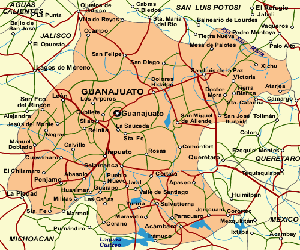
6/5/11 - Children of Guanajuato, Mexico in Biometric D-Base

Children of Guanajuato, Mexico in Biometric D-Base

by Alexander Weinstock May 6th, 201

Guanajuato - Mexico's kidnapping capital.

Biometrics is penetrating deeper into our lives than ever before. Next-generation passports with stored fingerprint data are being issued in almost every country. Russia is moving toward a universal identification card, supposed to arrive sometime next year, which we have covered before. However, of all countries, Mexico is really taking a step into the future when it comes to biometrics. It all started last September, when the residents of the city of Leon were due to be secured through iris scanning. Now, they are taking it to the next level, registering all children of the state of Guanajuato in a biometric database, which includes iris and fingerprint information.

If things will continue to develop this way (and there is currently no reason for them not to), in ten more years we will probably live in a world where each one of us can be identified in any database by an eye scan, or fingerprint, or miniscule blood sample. At the risk of sounding trite and repetitive, I do have to say that this initiative brings to life what the filmmaker Steven Spielberg only imagined in his 2002 sci-fi drama, Minority Report. Ironically, I just happened to be recently watching that movie with my family, and amidst the action and cool special effects, my father and I struck up a discussion on whether or not the eye scanning system shown in the film was actually realistic. I argued that while it is definitely technically possible, we were a long way off from implementing it on a large scale, because, I thought, we do not yet have machines that scan many people at a time, and, on the ethical side, there would be many legal issues to work out before something like this was allowed to be put in practice. Little did I know…
As can be seen from the above examples, many countries are already passing legislation that will allow them such, at first glance, Orwellian measures. On the technical side, the units in Leon are capable of scanning approximately 30-40 pairs of eyes per minute, and that rate is only going to increase as the technology keeps improving. That is about a class and a half of schoolchildren. Speaking of schoolchildren, let us go back to the situation in Guanajuato, Mexico.  The children are and will be enrolled in the system almost from their very birth and this raises a sizeable wave of protests among residents of Mexico and other countries as well. The primary concern is that this is one more piece of information that is going to wind up in a centralized government database and will be used to track every living person enrolled, resulting in some soon-to-be global police state.

It is true that for some reason, perhaps because it is an intrinsic human characteristic, or as a reactionary measure to the widespread transparency of today, modern society is extremely protective of its privacy. I am no stranger to that notion and enjoy keeping my business my own as much as the next guy, but in this particular case, people’s fears are very much blown out of proportion, even though their premise is legitimate. In order for the government to track someone’s position in the world, it is not necessary to implement a biometrics database. All that is needed is to hone in on the signal emitted by one’s mobile phone (even if it is not making a call), and since virtually everyone owns a cell phone nowadays, virtually everyone can be tracked.
Before anyone rushes to throw his or her SIM card out the window, though, let me jump slightly ahead and say that this is just the nature of the world we live in. Geographic positioning and other tracking methods are simply the other side of the coin of rapidly improving communication technologies. Moreover, we volunteer information every day.  A person can be very accurately profiled based on his or her credit purchases and everyone’s loan and credit histories are directly linked to their social security number. The fact of the matter is, the government already has all of the information it needs to track any person in its jurisdiction. That is why fighting against progress out of privacy concerns is ridiculous. Those energies would be much better spent to influence politicians to pass appropriate legislation protecting an individual’s privacy from being invaded without due cause.

Much safer than a passport.
Biometric iris identification, however, is even less a tracking device than it is a convenient feature that can also be used to improve safety. Newborn children were enrolled in the program in Guanajuato, Mexico because that particular state has had a history of child kidnappings for at least three years. Iris scanning is a much more effective way to determine someone’s identity, which makes it harder for kidnappers to pass the baby off as their own.

Many American opponents of this idea argue that this will not help, as most kidnappers are actually the child’s relatives. However, their mistake is that they are transposing American reality onto Mexican soil. The situation in places like Guanajuato is much more serious than most of us can imagine. Kidnapping has become a lucrative business and is no longer driven solely by personal or familial motives. It is because the situation is so volatile that I think compiling a central biometric database is more than warranted, especially since, and I would once again like to stress this, it does not curtail privacy any more than it already is.

Scientific and technological progress is being made all the time. Biometrics is entering our lives in a big way and it is not going away. Perhaps in the near future we will be able to discard most of our identifications such as passports, driver’s licenses, etc. in favor of a single, simple iris scan. Contrary to the popular belief this will actually be safer, since it is much harder to forge an eye signature than it is to make a fake passport. As new technology continues to develop, we have to remind ourselves not to fall into panic, and that it is only a tool. What matters more are the decisions we make with it.

Saturday, 7 May 2011

6/5/11 - 6 Threats to Free and Open Access to the Internet

6 Threats to Free and Open Access to the Internet

Activist Post

Many of us believe the Internet to be open and free for us to explore all known information.  Indeed, it is true that we currently can surf to any active website with our browser, and we can start a website or blog on any topic we wish to discuss.  And it is quite a profound concept that everyone with a smart phone literally has all of the world's knowledge in the palm of their hand.

Ben Franklin knew well the importance of free access to information when he founded the first public library in America to share knowledge with those without the means to their own books.  Today, he surely would consider the Internet's unprecedented access to information, and ability to communicate it instantly, as the ultimate level playing field of economic mobility and freedom.

However, this access is now under threat of authoritarian control.  First, it is important to note that the gears of the Internet have always been controlled by central authorities, as Douglas Rushkoff recently wrote, "From its Domain Name Servers to its IP addresses, the Internet depends on highly centralized mechanisms to send our packets from one place to another."

Therefore, the idea that our movements on the Web are even remotely private or untraceable is false.  The central "authorities" who control the gears of the machine know exactly where you have been, while Google and the CIA have even developed ways of knowing where you're going next as well.  It's very creepy to know that our every move is being tracked, traced, and databased, but it has been happening from day one on the Internet, and will likely continue to happen despite the violation of basic rights to our privacy.


Because Internet privacy has never been possible in the current web infrastructure, any proposed "privacy law" would just seem to pay lip service to the idea if it doesn't address decentralizing the control grid.  As Rushkoff pointed out, "I'm not trying to be a downer here, or knock the possibilities for networking. I just want to smash the fiction that the Internet is some sort of uncontrollable, decentralized free-for-all, so that we can get on with the business of creating something else that is."

The focus here will be on the multitude of threats to our free access to the current Internet.  As Ben Franklin understood, information should be free and open to all, not just the select few.  Although the books in Franklin's first library were indeed copyrighted material, they were freely shared.  We should think of the Internet as a gigantic open-source public library.  A place where information such as news, books, movies, and music should be free to view while we're visiting the library.

Unfortunately, those who have control over the grid and influence over policymakers do not view the Internet in the same light.  It appears that they view it as an economic and propaganda playground -- the last one that they don't fully control.  Well, given the blight of proposed Internet control laws and web censorship tactics, it seems there is a calculated effort to control the free flow of information.

Below are 6 threats to our free and open access to the World Wide Web:

Legislation: The Protecting Cybersecurity as a National Asset Act, aka the "Internet Kill Switch" bill, has recently been reintroduced with a new Orwellian name, the Cybersecurity and Internet Freedom Act. This bill would give government the unchecked power to restrict access to the Internet if they declare a "national cyberemergency."  CNET recently reported:
But the revised wording (PDF) continues to alarm civil liberties groups and other critics of the bill, who say the language would allow the government to shut down portions of the Internet or restrict access to certain Web sites or types of content. Even former Egyptian President Hosni Mubarak didn't actually "shut down" the Internet: at least at first, a trickle of connections continued.
The second piece of legislation that's being reintroduced this year is the Combating Online Infringement and Counterfeits Act (COICA).  This bill, clearly written by the mega-media entertainment cartel, would empower the U.S. Department of Justice to shut down, or block access to, websites found to be illegally sharing copyrighted material.  It gives the government the authority to force Internet Service Providers to block access to websites from certain IP addresses, much like how the U.S. recently blocked the Al Jazeera feed during the Egyptian protests.  COICA has also been referred to as the "Blacklist" bill because it allows the government to blacklist or seize any domain name suspected of infringement -- even if located outside the United States.

DHS Seizures: Who needs there to be laws on the books when the Department of Homeland Security appears to already be above the law. DHS has been on a rampage of arbitrarily seizing websites without due process.  In November 2010, they seized over 70 websites suspected of copyright infringement.  Just before the Super Bowl, DHS seized another lot of domains for illegally share-streaming sporting events -- some merely for linking to copyrighted material.  Most recently, DHS erroneously seized 84,000 domains accused of being affiliated with child porn in some way which the DHS later admitted was done by accident.  

Clearly, DHS has displayed its technical ability to censor the Internet by removing these websites. And although the domain seizures were technically accompanied by a court order, it seems that the DHS has partnered with large media outlets and sports entertainment to protect their profits. Finally, these court orders are a guilty-until-proven-innocent ruling which can irrevocably damage small businesses and the livelihoods of many people whose path to justice remains unclear.

Civil Lawsuits: Again who needs laws when you can be frivolously sued in civil court over copyright issues and bullied into settling the claim. Copyright infringement trolls like Righthaven are suing blogs and sites, and despite the only court ruling to date being a dismissal of charges due to Fair Use rights, they are still forcing many settlements.  In fact, even Internet giant Drudge Report was forced to settle a civil suit involving a copyrighted image and link.  

According to Steve Green, who's been diligently covering these lawsuits for the Las Vegas Sun, claims they are a new type of legal enterprise:
Attorneys say the Righthaven lawsuits are unprecedented in recent memory because, in the past, newspapers dealt with online copyright infringement by simply asking infringing websites to remove the infringing material and to replace it with a link to the source newspaper. Most Righthaven defendants say they were sued without warning.
Not surprisingly, most of the cases are settled out of court.  However, this tactic is a very effective intimidation tool against small websites who seek to share information.  In some cases the costs and aggravation of combating the lawsuit can force the closure of these website defendants.

Net Neutrality: It would seem that net neutrality should fall under the legislative category. However, it is actually considered more of a "market based" regulation than actual law, yet the taxpayer still funds its enforcement through the FCC.  Before identifying the reasoning behind and specific aspects of net neutrality rules, it's worth noting that Internet futurist, Douglas Roshkoff, views the details as irrelevant because:
The moment the 'net neutrality' debate began was the moment the net neutrality debate was lost. For once the fate of a network -- its fairness, its rule set, its capacity for social or economic reformation -- is in the hands of policymakers and the corporations funding them -- that network loses its power to effect change. (source)
The concept behind net neutrality is just what it says; to keep Internet access neutral for all users. But again, it is a very Orwellian term where true supporters of a free an open Internet can be tricked into supporting so-called neutrality rules.  Blogger Timothy Karr wrote, "The rule is so riddled with loopholes that it's become clear that this FCC chairman crafted it with the sole purpose of winning the endorsement of AT&T and cable lobbyists, and not defending the interests of the tens of millions of Internet users."

What they are, in fact, are rules to allow service providers to charge tiered price levels depending on the amount of broadband used by individual web-surfers or websites.  In other words, certain access will be discriminated against through reduced access speeds or additional fees.  Besides limiting size of the surfer's information wave, this tiered approach to the Internet will likely make it very difficult for smaller websites to compete with the big boys who can afford to pay ISPs for unadulterated access.

Technical Censorship:  Google, Facebook, Youtube, Twitter and Wikipedia have become the most powerful information sharing tools the world has ever known. Combined, these five websites could literally rewrite history or shape the entire flow of current information if they chose to do so. Indeed, each of these virtual libraries has been repeatedly accused of censorship in many various forms; from blatant removal of content to manipulating the searchable strength of disapproved content.

Google, who seems so powerful that they may actually run the world, recently revealed that they are tweaking their search algorithm to weaken the search engine ranking of information aggregating websites referred to as "content farms."  It seems that Google seeks to reduce websites with little original content to the level of spammer status in their search results. What's more, Google can wield the power of their Google Page Ranking for individual sites.  Their constantly changing algorithm may actually penalize websites for search engine optimization, as with the recent case of JC Penney losing business due to Google penalizing them for SEO.

Taxes:  If Congress or local governments elect to tax websites, the level playing field on the Internet is finished.  In May 2010, the Federal Trade Commission proposed the "Drudge Tax" which would seek to tax news aggregators as if they are brick and mortar media companies. The FTC report also suggested that news aggregators be forced to pay copyright fees to link to mainstream news sources.  And in perfect wealth distribution fashion the report also discusses the "possibility of offering tax exemptions to news organizations, establishing an AmeriCorps for reporters and creating a national fund for local news organizations."

More recently, some states have proposed taxing online retailers such as Amazon, arguing that it's not fair for local retailers who must pay taxes for selling the exact same items.  In the past, Amazon has terminated its contracts with third-party affiliates in states who have adopted online tax laws. California Congressman, Dan Lungren, introduced the resolution Supporting the Preservation of Internet Entrepreneurs and Small Businesses aimed at preventing states from imposing these new taxes on online retailers.

What's more, some states and even municipalities are beginning to impose a blogger fee referred to as a "privilege license" as a sort of business license for blogs.  Philadelphia has forced bloggers to pay a $50/year, or $300 lifetime, fee for the privilege of expressing ideas online.

Conclusion
It seems clear that the powers-that-be are engaged in an all-out assault the free flow of information on the Internet.  Blogs and websites must be prepared to combat the coming onslaught of news laws, regulations, and fees.  For those who believe information should be free for all who pay for Internet access, we must fight to maintain this liberty.  Stay tuned to the new blog Sites & Blogs for breaking Internet news and legal commentary about online copyright and privacy rights.