We read in Revelation about things that must happen in the Last Days:
Rev 13:15-18 And there was given to it to give a spirit to the image of the beast, so that the image of the beast might both speak, and might cause as many as would not worship the image of the beast to be killed. (16) And it causes all, both small and great, rich and poor, free and bond, to receive a mark on their right hand, or in their foreheads, (17) even that not any might buy or sell except those having the mark, or the name of the beast, or the number of its name. (18) Here is the wisdom. Let him having reason count the number of the beast, for it is the number of a man. And its number is six hundred and sixty-six.
This Blog deals with the Mark of the Beast and to link current world events and Technology with end time prophecy to see where we stand in regarding to the return of Jesus Christ / Messiah Yeshua.
We will look at technology that supports this passage as well as the "changing" of humanity through Transhumanism and population reduction and how technology and food engineering help the elite to reach their goal of 500 Mil people on he Earth.
The pioneering British computer genius Alan Turing, one of the team who created the primitive computers that cracked the German Enigma code, had a simple test for a machine that could 'think'. The computer had to be able to fool human beings into thinking they were talking to a person, not a machine. At the Techniche computer festival in Guwahati in India this week, software called Cleverbot succeeded in fooling 59.3 per cent of 1,334 voters that it was a human being - far more than had participated in any previous official 'Turing test'. Has someone finally created an intelligent machine? 'You could argue that by fooling more than 50 per cent of the people, Cleverbot has passed a Turing test,' says the software's British creator, Rollo Carpenter, talking to Mail Online today. 'But there is no universal test,' says Carpenter. 'And it is the subject of endless debate. The approach we used was less 'academic' than many.' Turing's original 'test' was proposed in a 1950 academic paper which asked, famously, 'Can machines think?' Although controversial, the 'test' remains crucial to our ideas of artificial intelligence - but this round is by no means a definitive 'win' for machine versus Man. Cleverbot was tested alongside humans, for 'control' purposes. Read More
Researchers at RIKEN, Japan's flagship research organization, have developed a ground-breaking new aqueous reagent which literally turns biological tissue transparent. Experiments using fluorescence microscopy on samples treated with the reagent, published this week in Nature Neuroscience, have produced vivid 3D images of neurons and blood vessels deep inside the mouse brain. Highly effective and cheap to produce, the reagent offers an ideal means for analyzing the complex organs and networks that sustain living systems.
Figure 1: Mouse embryos Left: embryo placed in phosphate buffered saline (PBS) after fixation with 4% paraformaldehyde (PFA). Right: embryo incubated in ScaleA2 solution for 2 weeks after fixation with 4% PFA.
Credit: Riken
Our understanding of biological organisms and how they function is intrinsically tied to the limits of what we can actually see. Even today's most promising techniques for visualizing biological tissue face this limitation: mechanical methods require that samples be sectioned into smaller pieces for visualization, while optical methods are prevented by the scattering property of light from probing deeper than 1mm into tissue. Either way, the full scope and detail of the biological sample is lost.
Figure 2: Three-dimensional reconstruction of neurons expressing yellow fluorescent protein (YFP) in 16 (8 x 2) quadratic prisms located in the cerebral cortex and hippocampus.
Credit: Riken
The new reagent, referred to as Scale and developed by Atsushi Miyawaki and his team at the RIKEN Brain Science Institute (BSI), gets around these problems by doing two things together that no earlier technique has managed to do. The first is to render biological tissue transparent. Scale does this significantly better than other clearing reagents and without altering the overall shape or proportions of the sample. The second is to avoid decreasing the intensity of signals emitted by genetically-encoded fluorescent proteins in the tissue, which are used as markers to label specific cell types.
This combination makes possible a revolution in optical imaging, enabling researchers to visualize fluorescently-labeled brain samples at a depth of several millimeters and reconstruct neural networks at sub-cellular resolution.
Already, Miyawaki and his team have used Scale to study neurons in the mouse brain at an unprecedented depth and level of resolution, shedding light onto the intricate networks of the cerebral cortex, hippocampus and white matter. Initial experiments exploit Scale's unique properties to visualize the axons connecting left and right hemispheres and blood vessels in the postnatal hippocampus in greater detail than ever before.
Figure 3: Image of nuclei of proliferating neural stem cells (green) and blood vessels (red) tunneling into the transparent hippocampus. The green signal comes from the Fucci S/G2/M marker.
Credit: Riken
But the potential of Scale goes much further. "Our current experiments are focused on the mouse brain, but applications are neither limited to mice, nor to the brain," Miyawaki explains. "We envision using Scale on other organs such as the heart, muscles and kidneys, and on tissues from primate and human biopsy samples."
Looking ahead, Miyawaki's team has set its sights on an ambitious goal. "We are currently investigating another, milder candidate reagent which would allow us to study live tissue in the same way, at somewhat lower levels of transparency. This would open the door to experiments that have simply never been possible before."
Before your mind hits overload, take the time to listen to the interview with Tom Horn on Future Quake Radio. If you are ambitious and have the time to delve into the extended insights of Mr. Horn, TransHumanism & Genetic Manipulation is an earth shattering experience. So what does this Transhumanism mean for mankind? Well, Joe Kovacs in World Net Daily quotes the aforementioned Mr. Horn again. “DARPA calls its project “ BioDesign,” and in its 2011 budget, the agency explains it “eliminates the randomness of natural evolutionary advancement primarily by advanced genetic engineering and molecular biology technologies to produce the intended biological effect.” Horn says the real purpose has to do with immortalism. “DARPA has an interest in figuring out how to get around the decaying process of cellular life, and they use the term creating an immortal organism,” he explains. “But it’s more than just an organism. They consider it to be potentially a lethal force that can be used in military application.”
The concept of Übermensch, is a German term generally associated with a superman. This Overman concept is much more than a school of thought viewpoint. It is a nightmare of untold propositions. Paul Kurtzis editor-in-chief of Free Inquiry. He states, “There is no word in the English language that adequately conveys the meaning of secular humanism. Secular humanism is not a religion; it represents a philosophical, scientific, and ethical outlook. I have accordingly introduced a new term, eupraxsophy, in order to distinguish humanistic convictions and practices from religious systems of faith and belief. Max More, Ph.D. goes deeper into the construct.
“The concept of eupraxophy encompasses within it humanism, transhumanism (including Extropianism), and possible a future posthumanism. Humanism is a eupraxophy or philosophy of life that rejects deities, faith, and worship, instead basing a view of values and meaningfulness on the nature and potentials of humans within a rational and scientific framework. Transhumanism is a class of philosophies that seek to guide us towards a posthuman condition. Transhumanism shares many elements of humanism, including a respect for reason and science, a commitment to progress, and a valuing of human (or transhuman) existence in this life rather than in some supernatural “afterlife”. Transhumanism differs from humanism in recognizing and anticipating the radical alterations in the nature and possibilities of our lives resulting from various sciences and technologies such as neuroscience and neuropharmacology, life extension, nanotechnology, artificial ultraintelligence, and space habitation, combined with a rational philosophy and value system.
Finally, Extropianism is the foremost version of transhumanism. While all transhumanists as such will agree on many overall goals, they may differ over the principles that will get us to a posthuman stage. The philosophy of Extropianism affirms the values of Boundless Expansion, Self-Transformation, Dynamic Optimism, and Intelligent Technology, and Spontaneous Order.”
Before your mind hits overload, take the time to listen to the interview with Tom Horn on Future Quake Radio. If you are ambitious and have the time to delve into the extended insights of Mr. Horn, TransHumanism & Genetic Manipulation is an earth shattering experience. So what does this Transhumanism mean for mankind? Well, Joe Kovacs in World Net Daily quotes the aforementioned Mr. Horn again.
“DARPA calls its project “ BioDesign,” and in its 2011 budget, the agency explains it “eliminates the randomness of natural evolutionary advancement primarily by advanced genetic engineering and molecular biology technologies to produce the intended biological effect.”Horn says the real purpose has to do with immortalism.
“DARPA has an interest in figuring out how to get around the decaying process of cellular life, and they use the term creating an immortal organism,” he explains. “But it’s more than just an organism. They consider it to be potentially a lethal force that can be used in military application.”
Putting aside the actual “weird science” technological developments and biological splicing chromosomal mutations, the basic issue of morals and ethics remain. All of Western Civilization is based upon the premise of “Natural Rights”. The implication that Natural Law is an inescapable component of individual purpose and social conduct is central to a cosmology of a grand design. The pursuit of understanding does not have to adopt a deist revelation in order to advocate a rational limitation on the human being. However, a belief in a divine creator is the very foundation of our common heritage and traditional culture.
The frontiers of Transhumanism scorns empiricism. The eupraxophy objective is to deny an external divinity, while professing to become gods in the process of honing their nanotechnology and neuropharmacology perfection. If Extropianism is possible, there is no need for a God Creator.
David Lawrence III, the editor of StrategicNews.com pens a provocative treatise called THE ELIJAH OPTION. The religious argument based upon the oral and written biblical record stems from an acknowledgement on the fallen nature of man. Even the most optimistic extropian transhumanist cannot deny the dismal documentation of man’s inhumanity to man. Evil is real and this fact permeates every aspect of social and metaphysical experience. Mr. Lawrence succinctly states the axiomatic, that every Christian should know and freely accept.
“God Almighty has no intention of helping man to install any kind of permanent command and control system for the management of evil, and it is monotheistic madness for any believer in the God of Abraham to attempt otherwise.
The entire purpose of the experiment on planet earth was to prove that evil does not work, and that we cannot live apart from Him. The moral law of the Almighty Creator is just as immutable as the natural laws that govern the universe. It cannot be broken.”
Transhumanism that rests upon a eupraxsophy of humanistic convictions that has no boundary of restrains, is erroneous. Wikipedia cites that the Ukrainian/Russian existentialist philosopher, Lev Shestov developed his reputation as an original and incisive thinker, In All Things Are Possible. Shestov adopted the aphoristic style of Friedrich Nietzsche and dealt with such issues as religion, rationalism, and science. His discovery of Kierkegaard prompted Shestov to realize that he shared great similarities, such as his rejection of idealism, and his belief that man can gain ultimate knowledge through ungrounded subjective thought rather than objectivereason and verifiability. The artificial ultraintelligent Overman, sees no need to seek this outside help to achieve the ultimate paragon. Thus lays the fatal flaw in the hubris of the nihilism that fixates upon the same arrogance of Lucifer.
The sanctity of the individual created human soul is synonymous within all beliefs in God. It is symptomatic of the Totalitarian Collectivism that dominates the drive to delink man’s - Similarity, Community, Values and Human Nature – that promotes the Transhumanism dialectic. The Elijah Option resolves,
“Mankind is on a collision course with destiny. The only thing that is not yet decided is the fate of each individual soul. Mankind will attempt to save itself, and in so doing, build the new world-wide city of Babylon, in defiance of the Almighty who declares that mankind will never succeed in the self-management of its own evil.”
Only a dullard believes that the insolvable global chaos is reversible through conventional means. Conversely, the Transhumanist readily professes that the New World Order fosters this disorder to further their migration away from the sub species that serves this new class of genetic Übermensch. The pitiful deniers that relinquish theirInherent Autonomy to this posthuman man-beast-robot entity, become not mere tools for their new masters, but actually provide no useful purpose for their continued existence.With a pretended sense of mercy and compassion the Transhuman eugenicists deems justified, their self-convinced supreme right in their own divinity. The irony that their secular humanism claim of not being a religion, begs the practice of a devotion to rule over the inferior human descendents that did not make the leap into the immortal realm.The essential question remains. Will the Transhuman have a soul in addition to their cyberspace matrix? Can a soul be created by an Extropianist or is a soul unnecessary baggage, when secular Transhumanism become the dominate ethic?
Sure preposterous postulations are reminiscent of the Genesis account in the rebellion of the cherub. Beelzebub goes high tech with the assistance of government research funding.
Britt Gillette of End Times Bible Prophecy referenced by Mr. Kovacs WND article, accordingly.
“Taken in its original context, Jesus did not necessarily say that unless those days are shortened, “humanity will not survive.” Instead, he said unless those days are shortened, “no flesh will survive.”
If the transhumanist movement succeeds in transforming the human race into a race of “posthumans” who no longer need flesh covered bones to survive, then these words of Jesus take on an entirely different meaning.
And it doesn’t take an illogical leap of faith to draw this conclusion.
After all, it seems reasonable to assume that humanity will have to undergo some sort of radical transformation in order to plot a war against God Almighty. The arrogant impulse already exists. All that remains is the need for an exponential increase in human power which deludes humanity into believing it can overcome the Lord of lords.”
Sounds like a Transhuman Satan featured in the final cut of the actual Apocalypse Now redux, waging an Armageddon in hopes of a different result. The New World Order has a decisive objective. The total subjugation of humanity is only a stage, leading to the elimination of all God fearing believers. The deification of substitute godsendowed by posthuman powers that overshadows Yahweh wants engineered Elohim clones.
The end of this age is rapidly approaching. What follows does not bode well for humanity under the reign of a Transhumanism world. Salvation for our created human beings from the evil transgressions of the Overman’s hubris requires our humbling before our Lord and Creator. Faith and belief is the alternative to malevolence and despair. Hope in providential intervention is intellectually founded and sound, when compared to the prospects of the DARPA superman. The Elijah Option challenges you. Whom do you serve?
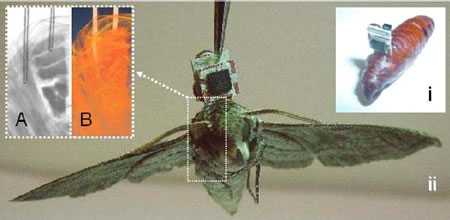
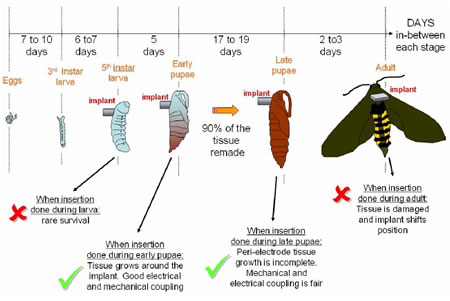
Cornell University researchers have succeeded in implanting electronic circuit probes into tobacco hornworms as early pupae. The hornworms pass through the chrysalis stage to mature into moths whose muscles can be controlled with the implanted electronics.
The pupal insertion state is shown in insert "i" in the picture seen above. The successful emergence of a microsystem-controlled insect is shown in insert "ii;" the microsystem platform is shown held with tweezers. The X-ray image (A) shows the probes inserted into the dorsoventral and dorsolongitudinal flight muscles. CT images (B) show components of high absorbance indicating tissue growth around the probe.
The research also indicated the most favorable and least favorable times for insertion of control devices. The overall size of the circuit board is 8x7mm, with a total weight of about 500 mg. The capacity of the battery is 16 mAh, and weighs 240 mg.
A driving voltage of 5 volts causes the tobacco hornworm blade muscles (two pairs) to move for flight and maneuvering.
DARPA HI-MEMS program director Amit Lal credits science fiction writer Thomas Easton with the idea. Lal read Easton's 1990 novel Sparrowhawk, in which animals enlarged by genetic engineering were outfitted with implanted control systems.
Dr. Easton, a professor of science at Thomas College, sees a number of applications for HI-MEMS insects.
Moths are extraordinarily sensitive to sex attractants, so instead of giving bank robbers money treated with dye, they could use sex attractants instead. Then, a moth-based HI-MEMS could find the robber by following the scent.""[Also,] with genetic engineering Darpa could replace the sex attractant receptor on the moth antennae with receptors for other things, like explosives, drugs or toxins," said Easton.
DARPA had better be careful with its insect army; in Easton's novel, hackers are able to gain control of genetically engineered animals by hacking the controller chips used in their implanted control structures.
Read more about Roachsters, full-size anthropod-based vehicles with embedded control structures from Easton's 1990 book Sparrowhawk.
If you are interested in one dark-side view of how this kind of invention could be used by corporations, see the madcap blurbflies from Jeff Noon's excellent 2000 novel Nymphomation.Learn more about HI-MEMS (Hybrid Insect Micro-Electrico-Mechanical Systems) Sought By DARPA; additional research reviewed at HI-MEMS: Cyborg Beetle Microsystem. Via Robot Watch. See also this informative articleDarpa hatches plan for insect cyborgs to fly reconnaissance.
Are men and women about to become superhumans who could hasten the 2nd Coming of Jesus?
Is mankind's quest for knowledge, power and longer life about to backfire and wipe human beings off the face of the Earth?
Secret experiments now underway in the U.S. and elsewhere are sparking fears of a potential extinction-level event hastening the 2nd Coming of Jesus.
For decades now, there have been science-fiction stories portraying a future filled with spectacular abilities for people, where the definition of what makes someone a human being is blurred by blending high technology and even animal traits into the human body.
In the 1970s, TV's"Six Million Dollar Man"featured Lee Majors as a critically injured astronaut rebuilt by the government to "make him better than he was – better, stronger, faster."
In 1982's classic film"Blade Runner,"Harrison Ford portrayed a futuristic cop who falls in love with a genetically engineered female "Replicant" while he looked to kill renegade androids seeking immortality.
And with major advances in technology in recent years, science fiction of the past could become science fact of our immediate future, with human minds connected wirelessly to computers and bionic bodies outperforming top athletes by leaps and bounds. That prospect has some sounding alarm bells about the fulfillment of End-times Bible prophecy and the possible vanishing of mankind through global warfare, disease, starvation or even – as strange as it sounds – replacement by other entities.
At the center of the debate is what is known as"transhumanism,"a term often used synonymously with "human enhancement."
Basically, it's a sort of regenesis, altering human bodies – genetically, mechanically or both – to make them better than they've been for thousands of years, affording them Superman-style abilities in both brains and brawn.
It's sometimes described by futurists as being "posthuman," what they believe is the next step in the evolutionary process.
Harrison Ford romances a human-facsimile "Replicant" played by actress Sean Young in 1982's "Blade Runner."
He says transhumanists want "to be resistant to disease and impervious to aging; to have unlimited youth and vigor; to exercise control over their own desires, moods, and mental states; to be able to avoid feeling tired, hateful, or irritated about petty things; to have an increased capacity for pleasure, love, artistic appreciation, and serenity; to experience novel states of consciousness that current human brains cannot access. It seems likely that the simple fact of living an indefinitely long, healthy, active life would take anyone to posthumanity if they went on accumulating memories, skills, and intelligence."
High on technology
With that in mind, scientific breakthroughs seen as beneficial to mankind are often trumpted with great fanfare in the media.
Resembling a skin tattoo, the Epidermal Electronic System (EES) consists of circuits which could contain electrodes to measure brain, heart and muscle activity, transmitting data wirelessly.
"What we are trying to do here is to really reshape and redefine electronics to look a lot more like the human body, in this case the surface layers of the skin," said John Rogers of the University of Illinois at Urbana-Champaign. "The goal is really to blur the distinction between electronics and biological tissue."
"The technique, they say, could give biologists 'atom-by-atom control' over the molecules in living organisms," the BBC reported. "What makes the newly created animals different is that their genetic code has been extended to create biological molecules not known in the natural world."
"It is just amazing," James told the Daily Mail. "My old artificial hand had a pretty basic open-close mechanism similar to a clamp. But with this one I can do everything. It also looks really cool – the outer-shell is see-through so you can actually see the mechanics working."
Research and destroy
But behind closed doors, there is more sinister genetic tinkering taking place, and that has some voicing grave concern.
He suggests people, as we now know them, are in the process of a man-made redesign in order to make them superbeings or even non-human entities.
"In terms of what transhumanists are aspiring to do through the use of these new sciences – biotechnology, nanotechnology, neuropharmacology," Horn says, "what they may do is lead us literally into the fulfillment of biblical prophecy."
"He wrote a white paper in which he considered the combination of those two to probably be the most dangerous science and technologcial and philosophical concepts in the history of mankind which he believes could very quickly lead to an extinction-level event," Horn says.
Horn claims the effort to transform humans into a different style of being is now being fast-tracked with billions of dollars.
"One of the first things that President Obama did at the executive level as soon as he became president," he says in"Trans-Humanism,""[is] he overturned restrictions that had been put in place by President [George W.] Bush which would have prohibited federal dollars, American taxpayer money, flowing in to pay for experiments to be done on human-animal chimeras (combinations) and other forms of science such as stem-cell sciences – which is also important to the transhumanist movement.
"But what most of the public doesn't realize is when we're talking about stem-cell sciences, we're almost always talking about the creation of a human-animal chimera from which those stem cells are being derived. But now, tax dollars in the United States from the federal level are flowing into thousands of laboratories."
"It's obvious that many of the genetic-based techniques used for diagnosis and treatment can also be used for enhancements," Prof. Max Mehlman said at the time. Strangely, says Horn, no public statements on the school's conclusions have been forthcoming.
Worthy of appaws?
As researchers have focused on blending animal attributes with human characteristics, theReuters news agency published a reportin 2009 in which scientists admitted their comfort with a "50/50 mix."
"The public mostly is still under the impression that this is being done at the embryonic level, and that the amount of human DNA in a transgenic animal is so minute as to be excusable," says Horn.
"But where they want the debate to go now is, 'Can we raise these to full maturity in the public's knowledge and experiment on part-humans, part-animals that are fully grown?' And by admitting that that's now where they want the public to be comfortable with this research, they also said that they knew that there are some rogue scientists out there that are not operating with federal dollars, and they're getting ahead of them in this technology and it could even become a new kind of a weapon of mass destruction. It could, at a minimum, become a molecular biological nightmare."
But why is there such a strong push for animal traits?
It might be desirable for some, says Horn, because, "Animals can also see into areas of the light spectrum that we cannot see into, and that is viewed in transhumanism as a future benefit and even one of the causal reasons we would want to merge ourselves with the animal kingdom so that we can open these new modes of perceptions into realities that right now we are blinded to."
Such abilities could provide a huge military advantage, and Horn says for more than a decade, theU.S. Defense Advanced Research Projects Agency, or DARPA, has been pouring billions into research for what it calls "the extended performance warfighter," also known as "supersoldier" technology.
"The interesting parts about the extended performance warfighter is that it even includes literally altering the DNA of soldiers," he says.
Some fear soldiers fighting future wars will be genetically enhanced to have some characteristics of animals in their DNA. (Image: Trans-Humanism DVD)
DARPA calls its project"BioDesign," and in its 2011 budget, the agency explains it "eliminates the randomness of natural evolutionary advancement primarily by advanced genetic engineering and molecular biology technologies to produce the intended biological effect."
Horn says the real purpose has to do with immortalism.
"DARPA has an interest in figuring out how to get around the decaying process of cellular life, and they use the term creating an immortal organism," he explains. "But it's more than just an organism. They consider it to be potentially a lethal force that can be used in military application.
"Wired Magazine actually referred to it as a living, breathing creature. And DARPA admits that the force of this living creature, this immortal organism, could be so potent that it ought to also have what they call a 'kill switch' introduced into its organism so that in case it gets out of hand, we could throw the switch and stop it, or if it became available to our enemies, we could throw the switch and stop it."
"They were talking about this kind of technology in the hands of our enemies, and what they were saying was, 'We have to get at the forefront of this technology,'" he explains. "See, this is how we're going to be forced into this. It's not a matter of whether we should or whether it's ethical. We have to do it, because if we don't, our enemies will, and then they're going to subjugate us to their will."
In the summer of 2008,Rep. Brad Sherman, D-Calif., chaired a House Foreign Affairs subcommittee focusing on the diplomatic and security implications of the spread of "genetics and other human-modification technologies."
Journalist Mark Stencel covered the hearing for Congressional Quarterly (now known as Roll Call), and seemed surprised at the topics discussed, ashe reported:
In some ways, the testimony sounded more like a Hollywood pitch for a sci-fi thriller than a sober discussion of scientific reality and diplomatic policy – with talk of biotech's potential for creating supersoldiers, superintelligence and superanimals, as the chairman put it. Witnesses mused about the convergence of nanotech, biotech, computers and cognitive science, with one warning that new applications could "put agents of unprecedented lethal force in the hands of both state and non-state actors."
There were discussions of genetic discrimination, eugenics and the civil rights of humans and animals whose intelligence might be enhanced or whose genes might be altered or integrated to the point that definitions become tricky. And witnesses warned of a genetic divide, in which enhancements would go only to the most privileged societies or individuals.
 The pioneering British computer genius Alan Turing, one of the team who created the primitive computers that cracked the German Enigma code, had a simple test for a machine that could 'think'. The computer had to be able to fool human beings into thinking they were talking to a person, not a machine.